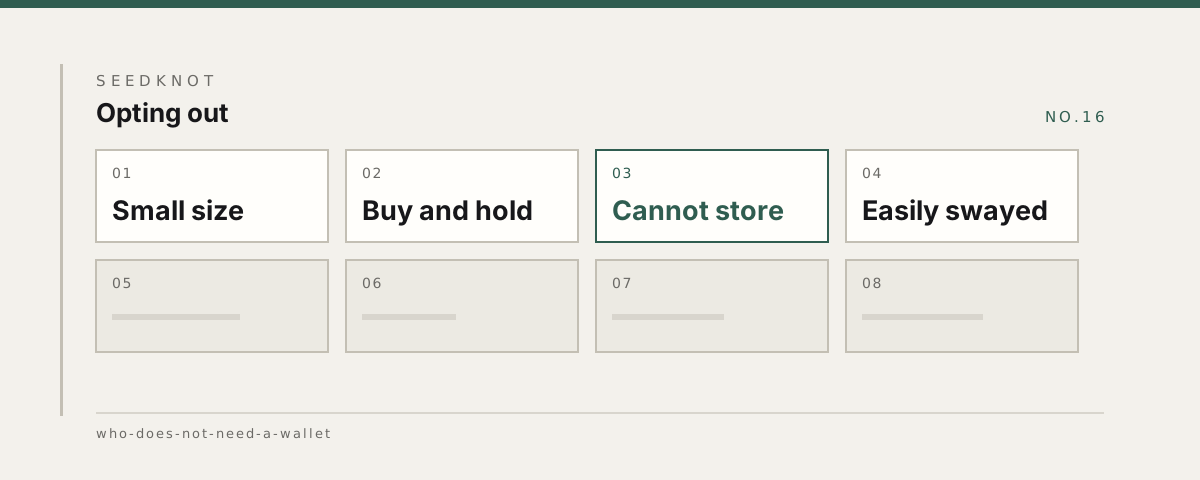
01Why this article exists
Because self-custody is not a straight upgrade, it is a risk swap. You exchange "the platform might fail" for "I might fail." For some people that swap increases total risk.
Almost everything written about wallets pushes in one direction: not your keys, not your coins, go and withdraw. The sentence is true, and it silently assumes that you can reliably store a string of words, read a signature request, and hold your nerve when someone impersonates support.
That assumption does not hold for a lot of people, and failing to meet it is not shameful. Pushing unsuitable people into self-custody produces real, irreversible losses that nobody is accountable for. Hence this article. If you recognise yourself below, this page is the most valuable thing this site can give you.
02You want to buy and hold, with no on-chain plans
If the entire plan is buy some, sit on it, sell it some day, then you will use essentially none of what a self-custody wallet provides. You do not need its capabilities, and you carry all of its risk.
What a wallet is genuinely for: interacting with on-chain applications, joining on-chain events, transferring without an intermediary. If you do none of those three, withdrawing changes exactly one thing — custody responsibility moves from the platform to you.
Effort is better spent hardening the exchange account: authenticator-based two-factor, a withdrawal address whitelist, an anti-phishing code, and a periodic look at active sessions. Do those and the remaining exposure is platform risk itself, which can be managed by spreading and by sizing.
"But what about platform risk"
The most common objection to this section, and a fair one. Our answer is not that platforms are safe — they are not — it is that platform risk can be managed and operational error cannot.
Concrete ways to manage it:
- Cap what sits on any one platform. Do not keep money you depend on in a single place.
- Use a venue that actually serves your jurisdiction, and check periodically that this has not changed.
- Keep the withdrawal path warm. Withdraw a small amount occasionally to confirm the process still works, rather than discovering on the day it matters that it does not.
- Have a second account ready on another platform, verified and idle.
Those turn platform risk from "everything at once" into "partial loss with somewhere to appeal". Self-custody errors have no such cushion — one mistake, total, immediate. That is what the word "swap" is doing in this article.
03Your holdings are small
At smaller sizes the fixed costs of self-custody stand out: time to learn, gas to manage, and a one-mistake-and-it-is-gone risk profile, in exchange for removing a platform risk that was proportionally limited anyway.
Count it honestly. Self-custody asks for a bag and a pen (negligible), a few hours understanding chains, gas and signatures, a network fee on every future transfer, and long-term physical security for a piece of paper. None of those scale down with the amount. They are fixed.
Put another way: the cost of self-custody does not shrink with the balance, while the risk goes to zero in one step. The smaller the amount, the worse the trade.
04You know you cannot store a string of words
If, thinking about it honestly, you are the kind of person who regularly cannot find important things, take that self-assessment seriously. A seed phrase gives no second chance.
Ask yourself, honestly:
- When did you last put an important document somewhere and still find it six months later?
- How many times have you moved? Did anything go missing each time?
- Would your instinct be that "a photo would be safer"?
- If a sheet of paper carried twelve English words you did not understand, would someone else in your household throw it out?
There are no right answers, only yours. If most of them give you pause, keeping funds somewhere with a recovery process is a rational decision rather than an evasion. Read what happens when a seed phrase is lost before deciding.
When you are deciding on behalf of an older relative
Worth separating out, because it is not only your money at stake. People regularly withdraw funds "to keep them safer" for a parent and then hand over a sheet of paper with twelve words on it. That arrangement is fragile at both ends: the recipient may not grasp what the paper is, and may not recognise the scripts used to obtain it.
If you are arranging this for family, consider:
- Ask whether they could handle it independently if you were unreachable. If not, the design is faulty.
- Custody is underrated in exactly this scenario: support, a recovery process and a risk system are precisely what an unfamiliar user needs most.
- The worst combination is self-custody plus no understanding plus the phrase stored in the phone — that collects nearly every risk on this site at once.
Handing complexity to someone who cannot manage it is not help.
05You are relatively easy to talk round
Self-custody has no risk system to hit the brakes. Every judgement — is this link safe, should I confirm this signature, is this person really support — happens in the moment, alone, quite possibly while you are stressed.
This is not about intelligence, it is about situation. Scams are designed to manufacture a context where thinking is not an option: a deadline, an account anomaly, funds at risk, migrate now. In a custodial setting, even if you click something you should not, risk systems and appeals catch part of the fall. In self-custody, the fall ends at the moment you press confirm.
If you or people close to you are susceptible to that kind of pressure — an older relative, a friend new to the space — keeping funds somewhere with support is objectively safer. The relevant path list is in how wallets actually get drained.
06What to do instead
Harden the account and size the position. Those two between them cover most of what an ordinary holder actually faces.
- Authenticator-based two-factor, not SMS alone. Store the backup key offline and separately.
- A withdrawal address whitelist, so "logged in and drained" stops being available.
- An anti-phishing code, so forged official emails identify themselves.
- A dedicated strong password for the email account, because it is the reset path for everything.
- Size the position so that no single platform holds money you depend on.
- Avoid leverage and derivatives; different products with a different risk structure entirely.
Where each of those settings lives is covered in section 04 of the exchange sign-up guide.
07When it is worth revisiting
When circumstances change: the amount grows meaningfully, you genuinely want to do things on-chain, or you have built a reliable habit of storing important physical items. Any one of those justifies re-evaluating.
If that day arrives, go slowly:
- Create a wallet holding a trivial amount and use it as a practice ground for a few months.
- Actually execute the seed phrase storage standard, including restoring from the backup once.
- Understand signatures and approvals before connecting to anything.
- Once all of that is routine, consider migrating a larger share.
Nothing about this needs finishing today. The most expensive mistakes in this field are almost all made in a hurry — a limited-time event, closing soon, act before it is too late. Anything genuinely worth doing does not give you ten minutes.
One last thing for anyone deciding against: the decision is not permanent and you owe nobody an explanation. You can come back to it at any point, and in the meantime, having your exchange account properly secured already puts you ahead of most people.