01Unpacking "not your keys, not your coins"
It means this: if the key that controls a crypto asset is not in your possession, the asset is yours on paper, but whether you can move it — and when — is decided by whoever is holding that key for you.
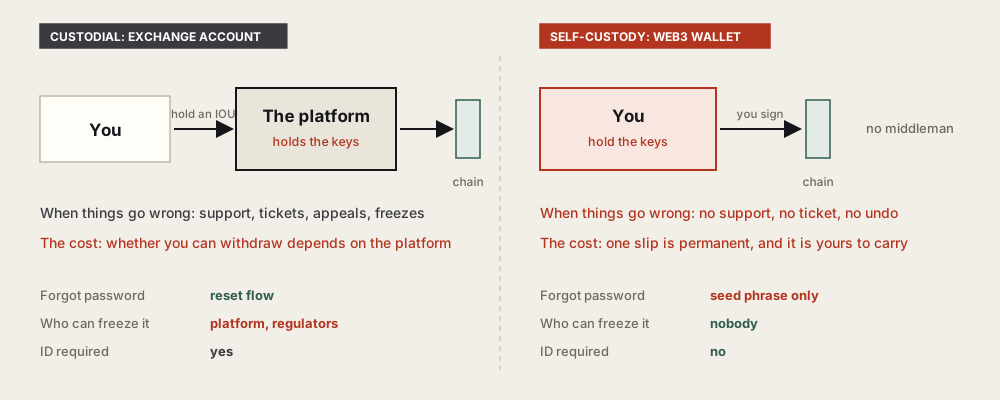
Most people hear the phrase as a slogan. It sounds right and refuses to attach itself to anything concrete. Translate it into ordinary language and it lands: the balance you see in your exchange app is a row in that company's database, and what it says is "this platform acknowledges owing you this much." Whether it corresponds to real coins sitting on a real chain depends on the company behaving. Usually it does. But that is trust, not structure.
Withdraw those coins to your own wallet and the situation changes shape. There is now an address on a public ledger, that address has a balance recorded against it, and only whoever holds the matching private key can sign it away. Nobody in the middle is acknowledging anything. The record itself is part of a ledger the whole network maintains.
Both states come with their own trouble, and the rest of this article works through it item by item. For now, here is a test you can apply to anything: ask yourself whether you could retrieve the coins if this company shut its doors tomorrow. If the answer is "yes, as long as I have my seed phrase," that is self-custody. If it is "depends how they handle it," that is custody.
02Exchange accounts: the platform keeps the ledger
An exchange account is an internal ledger maintained by a company. Coins you deposit land in the platform's own wallets, and the platform credits you in its database. When you trade, the numbers in that database move; nothing happens on any chain.
This design is not laziness, it is necessary. Settling every fill on-chain would collapse under the volume and cost of an order book. So centralised exchanges nearly all work this way: the chain is touched at deposit and at withdrawal, and everything in between happens internally.
The upside is genuinely valuable:
- Actions can be walked back and disputed. Forget a password and there is a reset flow. Someone logs into your account and it can be frozen. Send to the wrong internal address and there is usually a ticket you can file. Someone picks up the phone — which is worth a great deal on the day you need it.
- The mental model is familiar. Register, verify, buy, sell. Close enough to a brokerage app that you never have to think about chains, gas or address formats.
- It is cheap. Internal transfers never touch a chain, so there is usually no network fee, and small amounts do not get eaten by costs.
The cost is equally real: your relationship to that company is a creditor's. Its finances, its regulatory standing and its risk policies all sit between you and your money. More than one platform has failed at this historically. That is not scaremongering; it is a thing this industry has done repeatedly.
Exchange apps usually have a tab called "Wallet" too — funding account, spot account, that sort of thing. That "wallet" is an internal partition of your account, not self-custody. The test is simple: did anything ever ask you to write down twelve words? If not, the keys are not yours.
03Web3 wallets: you control the asset directly
A Web3 wallet does not store your coins. It stores the private key that can move them. The coins stay recorded on the chain; the wallet is a tool that signs and reads balances.
This is where the word "wallet" misleads hardest. It is closer to a keyring than a billfold. Delete the app and the coins do not vanish; restore the same seed phrase on a different device and the balance is exactly where it was. That thread runs through the piece on losing your phone.
What a wallet actually does comes to three things:
- Store the private key. Typically the key, derived from your seed phrase, is encrypted into local device storage and unlocked with a password or biometrics.
- Read chain state. It connects to a node service and asks what balances and tokens exist under your address, then displays them. This step is read-only and needs no key.
- Sign with the private key. When you send or interact with a contract, the wallet signs that operation and broadcasts it.
Nobody approves any of it. That is the entire appeal and the entire danger: once a signature is out and included in a block, there is no undo button.
For how keys, public keys and addresses derive from one another, see private key, public key, address. For the relationship between a seed phrase and a key, see seed phrases and private keys.
One form that gets misread
Several large exchanges now ship their own branded Web3 wallet, sitting in the same app as the trading account. People assume that means the keys stay with the exchange. That is not automatically true, and it varies by product: some are ordinary self-custody wallets that make you write down a seed phrase and warn you it cannot be recovered; others use key-sharding schemes where recovery is split across parties, one of which may be the platform or a third party.
Those two differ enormously on "who do I turn to when something breaks." So ignore the brand and read the setup flow:
- It asks you to write down a set of words and confirm them back, and tells you plainly that losing them is final — self-custody, the responsibility is yours.
- A phone number, email or social login can "recover the wallet" — recovery is not entirely in your hands. The convenience buys you an extra party that can be compromised or compelled.
Neither is dishonest, but you should know which one you took. If you cannot tell, read that product's own help documentation on recovery — the vaguer it is, the more careful you should be. Binance publishes an overview of its wallet on its public product page; the same approach applies to any brand. Read the documentation before you decide how much to put in.
04Eight dimensions, side by side
The table below is the skeleton of this article. If you have two minutes, this is the part to read.
| Dimension | Exchange account | Self-custody wallet |
|---|---|---|
| Who holds the key | The platform | You |
| What you actually own | A claim against the platform | The ability to move a chain asset |
| Who can freeze it | The platform can, and will under regulatory pressure | Nobody can freeze your address directly |
| Forgotten password | Reset flow, usually recoverable | Password resets, but a lost seed phrase ends it |
| Sent to the wrong address | Internal transfers may have a ticket path; on-chain withdrawals are just as final | Irreversible; only a voluntary return helps |
| After a theft | You can appeal, and related accounts may be frozen | Nobody to appeal to, recovery near impossible |
| ID required | Major platforms require verification | Creating a wallet needs no identity at all |
| What you can do | Trade, earn products, fiat in and out | Send on-chain, use contracts, claim distributions |
Notice that no row says which is better. Of the eight, custody wins three, self-custody wins three, and the remaining two cost something either way. That is precisely why this question has no single answer.
05Who can freeze your money
An exchange can freeze your account — risk controls, a regulatory requirement, or a question about where your funds came from. A self-custody balance has no switch anyone can flip, which does not mean it is safe.
On the custodial side first. Freezes are not rare, and the common triggers are: the risk system flagging an unusual login, verification documents being questioned, or funds you received through a peer-to-peer trade turning out to be connected to a case upstream. That last one catches ordinary people regularly — you sell coins, receive a bank transfer, and that money happens to be traceable to a fraud complaint. Your bank account and your platform account can both get caught in the same net. These take a long time to resolve, and you are the one supplying documentation.
On the self-custody side, an address has no off switch and no support agent who can stop it. But two things need saying, or the claim is overstated:
- Centrally issued tokens can be restricted at the contract level. The major dollar stablecoins are controlled by their issuing companies, which can and do blacklist addresses so that those addresses cannot move that token. That is not a property of the chain; it is a capability written into that particular token contract.
- "Nobody can freeze it" also means nobody can protect it. If the key leaks, whoever has it needs no approval either. Section 09 returns to this.
If the thing you fear is "the platform holds my money hostage," self-custody genuinely solves that. If the thing you fear is "I make one wrong move and it is gone," self-custody makes that worse. Work out which one you are actually afraid of before choosing.
06Forgetting a password on each side
Forget an exchange password and you verify your way back in; the account survives. Forget a wallet password and, provided the seed phrase still exists, you reinstall and restore. If the seed phrase is gone too, that asset is locked permanently and nobody can open it.
This is where beginners misjudge most often, because "password" refers to two unrelated things in the two contexts.
The password in a wallet app exists to unlock local storage. It is not the credential to your assets. The credential is the seed phrase. So forgetting the wallet password is not serious — uninstall, reinstall, restore from the seed phrase, set a new one.
What is serious is the other case: the seed phrase is gone. There is no "recover seed phrase" feature, because the design contains no party who knows yours. We wrote that out bluntly in what happens when a seed phrase is lost.
People "keep it safe" by putting the phrase in a cloud notes app, a chat app's saved messages, or the camera roll. What those places have in common is that they sync to some cloud account whose security is far below the level a seed phrase deserves. The full list of exposure routes is in how wallets actually get drained.
07Wrong address, stolen funds: who helps
An on-chain transfer is irreversible once confirmed, and that applies equally to an exchange withdrawal and a wallet transfer. The difference is whether there is anyone to ask afterwards: an exchange has tickets and a risk team; a self-custody wallet has neither.
Sending to the wrong address
Move funds to another user on the same platform and the platform has records; it can try to contact them or run a dispute process. Whether you get the money back is uncertain, but somebody at least accepts the case. Withdraw on-chain to a mistyped address and it is no different from a wallet mistake — the coins are at that address, and whether they come back depends entirely on whoever controls it.
The nastier variant is picking the wrong network: you withdrew over a chain the recipient does not support. Causes and the odds of recovery are covered separately in what a chain is, and what happens when you pick the wrong one.
An account or wallet gets compromised
With a compromised exchange account you can contact support immediately, freeze it, and file a claim. If the attacker withdrew to another platform, the two risk teams can sometimes cooperate. None of it is pleasant, but a path exists.
A drained self-custody wallet has no such path. You can watch the transaction get included on a block explorer and watch the funds move to the next address, and that is the extent of it. You can file a police report and ask communities to flag the address, but no mechanism exists to reverse a confirmed transfer.
Which is why this site spends its length on before: reading signature requests, clearing out approvals, auditing how you store the seed phrase. There is no after. There is only before.
08ID checks and what you can actually do
Major exchanges require identity verification for full functionality; creating a Web3 wallet requires no identity information whatsoever. But a wallet cannot buy or sell for you, and converting government money into crypto still runs through a licensed venue.
Verification cuts both ways. It is a real barrier and it does mean handing over documents. It is also the precondition for having any right of appeal and any fiat rails at all. Without an identity there is no counterparty who can resolve a dispute for you.
The functional gap is worth stating too:
- An exchange does fiat deposits, spot and derivatives trading, savings products, and comes with support and risk controls.
- A wallet does on-chain transfers, interaction with decentralised applications, and participation in on-chain events. Swapping inside a wallet routes through on-chain exchange contracts, which costs a network fee and prices at whatever liquidity exists at that moment.
So in practice most people run both: convert money to crypto on a platform, withdraw the portion they intend to hold long-term or use on-chain into their own wallet, and leave the rest where selling is easy. If you are going down that road, the account comes first — see the exchange sign-up guide — and the withdrawal itself is in moving coins from an exchange into your wallet.
09The cost of self-custody, stated plainly
Self-custody permanently hands you three things: no recovery, no undo, no support. Mistakes are yours, and they tend to be one-shot and unrecoverable.
Most writing on wallets emphasises that you finally control your own assets. True, and half the story. The other half of control is responsibility, and responsibility only becomes visible when something breaks. Four parts:
One: no recovery
The seed phrase is the only credential. Lost, burned, water-damaged, or copied down wrong with no second copy — same outcome. "Contact the official team to verify my identity" is not an option here, because the wallet's developers do not have your phrase.
Two: no undo
Once a transfer is signed and included in a block, it is done. An extra character in the address, the wrong network, a test amount typed as the full balance — all things a phone call could stop in traditional finance, and none of them stoppable here.
Three: no support
A wallet's support team can help with interface problems, not asset problems. And in practice, "support" that contacts you first and offers to restore your wallet is essentially always a scam. The shapes those take are in how wallets actually get drained.
Four: judgement calls you are not trained for
Deciding what a signature request is actually authorising, spotting a cloned site, choosing whether to grant a contract unlimited allowance — a custodial environment has risk systems making some of those calls for you. Self-custody does not. Get one wrong and there is no second attempt.
If the amount is modest and you have no plans to do anything on-chain, those four risks very plausibly outweigh the platform risk they were supposed to remove. That is not timidity; it is what you get when you price both sides. Longer version: who does not need a Web3 wallet.
10So which one should you use
Choose by use, not by allegiance. Trading, fiat, modest amounts and no on-chain plans: stay on the exchange and configure its security properly. Long-term holding, on-chain activity, or an unwillingness to carry platform risk: self-custody, starting small.
Concretely:
- You just want to buy a bit and watch it: an exchange is enough. Turning on two-factor and a withdrawal whitelist does more for you than rushing into a wallet.
- You want to claim distributions, use decentralised apps, do things on-chain: you need a wallet, there is no substitute. Start with one that holds small amounts and treat it as the cash in your pocket.
- You have a holding you intend to keep for years: self-custody deserves serious thought, paired with offline storage of the seed phrase and, above a certain size, a hardware wallet. Differences in hot wallets and cold wallets.
- You know you cannot reliably store a string of words: then do not force it. That is not embarrassing, and it is a great deal more rational than finding out later.
There is also an underrated answer: use both, split by purpose. Trading stays on the platform, long-term holdings sit in your own wallet, and on-chain interaction happens from a separate low-value wallet. Then no single failure takes everything at once.
If you are going ahead, the next step is setting up your first wallet. Before that, read seed phrases and private keys — the most consequential moment of the setup happens there.