01Who holds the key
This is the root difference between the four; everything else follows from it. The test is simple: did setup make you write down a seed phrase.
| Type | Who holds the key | If you forget | ID required |
|---|---|---|---|
| Exchange account | The platform | Recovery flow, usually works | Yes |
| Mobile wallet | You, in local phone storage | The seed phrase, with no alternative | No |
| Browser extension | You, in extension storage | The seed phrase, with no alternative | No |
| Hardware wallet | You, in an offline device | The seed phrase, with no alternative | No |
There is also the category of exchange-branded Web3 wallets, which take one of the shapes above but vary in recovery design — some are ordinary self-custody, others split recovery across parties including the platform. Read the documentation on recovery rather than the brand.
02What each blocks
| Type | Main risks it blocks |
|---|---|
| Exchange account | You losing the credential, you making an irreversible mistake, and being phished but still having an appeals channel; risk systems intercept some anomalous withdrawals |
| Mobile wallet | Platform failure and platform-imposed freezes; biometrics stop someone who picks up the phone |
| Browser extension | Platform risk; lets you interact with sites on a computer without handing them a key |
| Hardware wallet | Platform risk; a program on a networked device reading the key; an independent screen for verifying what you are signing |
03What each cannot block (this is the column that matters)
None of them stops you pressing confirm on a cloned page. Hardware included — it locks the key away, and the judgement stays with you.
| Type | Cannot block |
|---|---|
| Exchange account | The platform itself failing; regulatory or risk-based freezes; funds received peer-to-peer being caught up in an upstream case; your password and verification methods being compromised |
| Mobile wallet | Seed phrase exposure; malicious approvals; counterfeit apps; clipboard address swaps; sending to the wrong address; losing your own backup |
| Browser extension | All of the above, plus counterfeit extensions, malicious page scripts prompting signatures, and everything else running on that computer |
| Hardware wallet | Seed phrase exposure or loss; a phishing site persuading you to press confirm on the device; malicious approvals; sending to the wrong address; a device of unknown provenance that was tampered with |
Three of the four have nearly identical cannot-block lists, and all three begin with seed phrase exposure and malicious approvals. Which tells you something: buying a more expensive wallet does not address the main risks. What does is getting seed phrase storage right (self-check) and learning to read signature prompts (how).
04Amounts and everyday friction
| Type | Suits | Friction | Typical use |
|---|---|---|---|
| Exchange account | Whatever you actively trade | Low | Fiat in and out, buying and selling, temporary parking |
| Mobile wallet | What you could lose today without it mattering | Low | Everyday sending, QR codes, small on-chain operations |
| Browser extension | Same; pocket money only | Medium | Interacting with applications on a computer |
| Hardware wallet | Clearly more than the device costs, held long term | High; the device comes out each time | Long-term storage |
No row here is "the best one". Friction and security scale together, and an arrangement too tedious to maintain will not be maintained — a hardware wallet you find annoying enough to skip backing up is more dangerous than a phone wallet you back up properly.
05Combining them
Most people should not pick one. Split into three by purpose: an exchange for what you trade, an everyday wallet for pocket money, and a vault wallet for the bulk that connects to nothing.
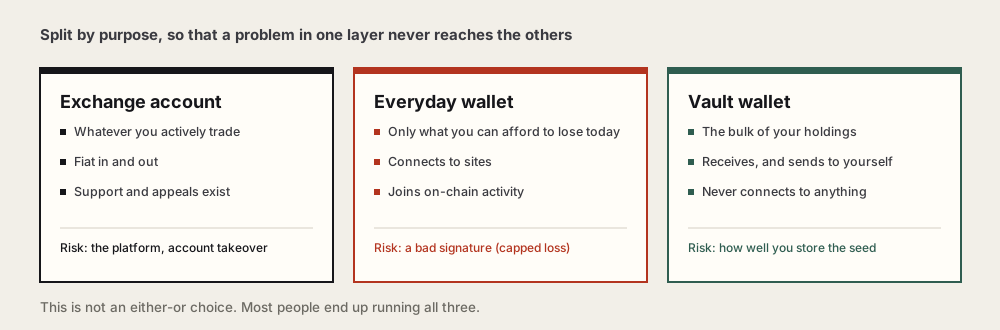
- Exchange account: fiat and trading. Configure two-factor, a withdrawal whitelist and an anti-phishing code.
- Everyday wallet (mobile or extension): connecting to sites and joining activity. Small amounts only, so a bad outcome has a ceiling.
- Vault wallet (hardware, or a hot wallet that never connects): receives, and sends only to your own addresses.
Related judgements are in hot wallets and cold wallets and Web3 wallet vs exchange account.
If this table makes a three-layer structure sound like too much and you have no plans to do anything on-chain, using only the first layer is a perfectly coherent choice. Who does not need a Web3 wallet is about exactly that.